Recently, I was reading about what research says about running training and marathon performance. Some large-scale studies that use Strava data are nicely summarized here. The article is great and informative. But it also includes a perfect example of a particularly counterintuitive and interesting way that data can be misleading about causality. I see this issue with some with some regularity, so I figured I’d take the opportunity to unpack this apt case.
The causal claim: long run training volume doesn’t matter for marathon performance
The article makes multiple causal claims about what will and will not drive improvements in marathon performance. When discussing long runs, the article says, “[Y]our long run distance probably isn’t what’s holding you back.” And elaborates later:
The long run is the training session most marathon runners worry about most. But the data suggests its length matters less than you’d think. That finding is striking. The high-volume group averaged 2.5x the weekly mileage of the low-volume group, yet both prescribed nearly identical long run distances. What separated the groups was everything around the long run.
So to reiterate, the empirical pattern is that most runners end up running similar long run training volume, and long run volume doesn’t predict marathon race performance. The article clearly treats this as evidence of a causal claim, concluding that runners should “stop chasing a longer long run” if they want to improve marathon performance. There are two problems with drawing causal lessons from this empirical pattern.
Issue 1: behavior truncate variation
The first issue is very simple. If, as the article says, everyone chooses to follow a training plan with “nearly identical long run distance,” there won’t be much variation in long run volume across runners, and estimates of any long run effect will be inherently low power. This isn’t an issue of causal identification per se. But it does mean it will be hard to estimate any causal relationship even if one exists.
I can attest that my amateur marathon running friends – regardless of whether they run a 2:35 (yes, I know an academic my age who ran 2:35; yes, I am jealous) or a 4:35 – all follow somewhat similar long-run training schedules, with a peak long run distance right around 20 miles. Thus, I’m not surprised this pattern appears more broadly.
Issue 2: behavior kills correlation
The deeper issue is that by working so hard to adhere to a long run training plan (as the article says, this is the training “most marathon runners worry about most”), runners can actually end up eliminating the predictive power of long runs in the data. This can happen even if long runs are absolutely crucial for marathon performance.
To see why, consider a simple example. Just so that the issue isn’t obscured by the variance truncation discussed above, let’s first assume that each runner is randomly assigned a target long run distance.
Then, substantively, let’s assume that marathon performance is primarily a function of two things:
- How close the runner runs to their target long-run training distance (in other words, their target long run distance is optimal for them, and they do better if they get closer to it during training)
- How much other running they do
Each runner has an exogenously assigned ability level, and we’ll let that ability level determine how much total training running the person does and how closely they adhere to their long run training plan. In other words, better runners will be more likely to hit their prescribed long run distance and they will do more other training runs. Seems reasonable enough.
Now we can simulate data for two cases. The second case will be the one that matches the pattern we see in the real data, but the first case is helpful for thinking about why the causal claim in the article is wrong.
For the first case, runners with higher ability are better able to adhere to their training plan for long runs, while runners with lower ability fall a bit short of their long run goal. This case is shown in the left two panels of the figure below. The top-left panel shows how close runners of different ability levels get to hitting their assigned long run training target, with 0 on the y-axis indicating perfect adherence to their training plan. As the bottom left panel shows, in this case long run distance ends up being a function of runner ability. Thus, ultimate marathon performance is also predicted by long run distance.
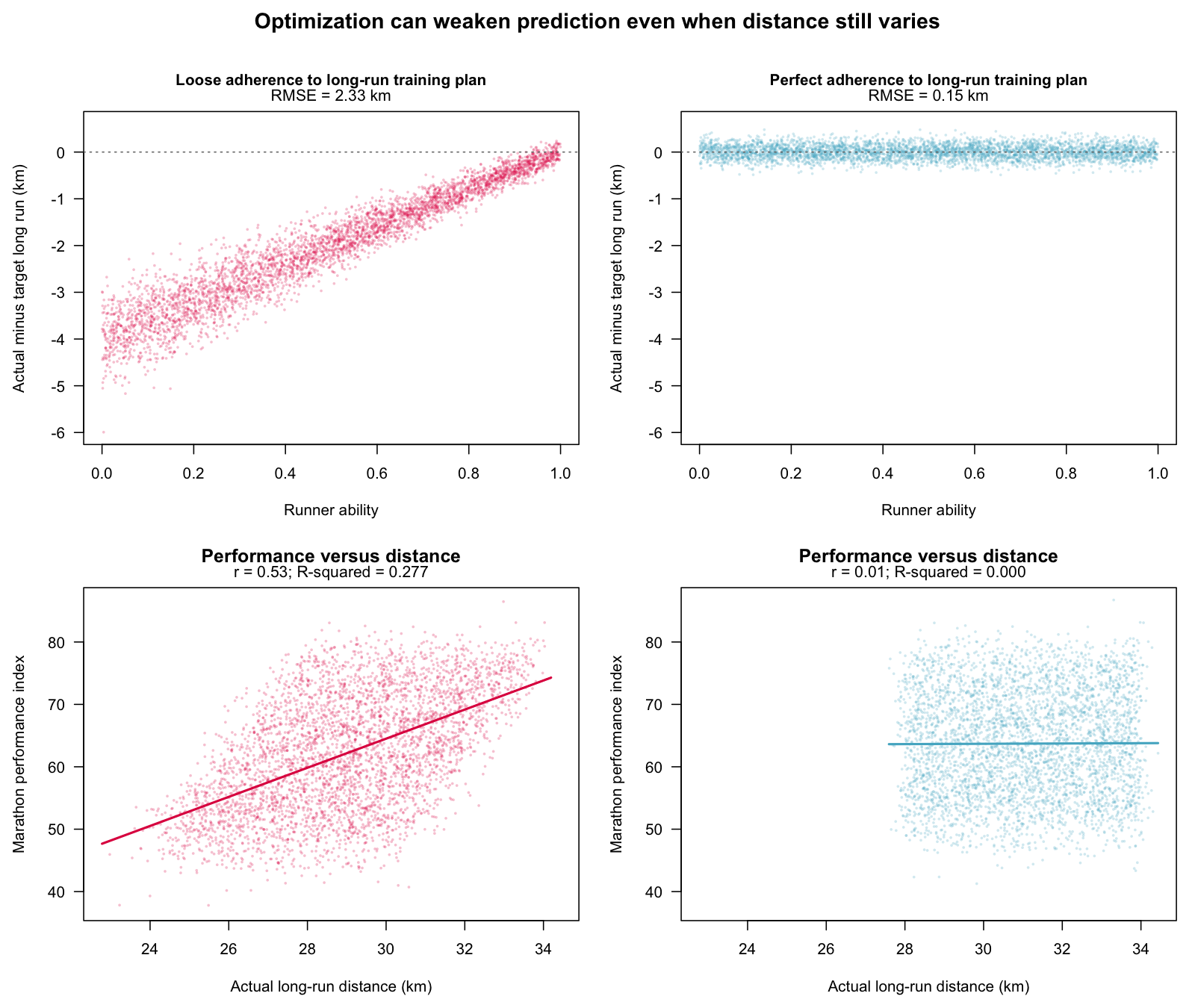
The second case is shown in the right two panels. These panels show the case where runners of all ability levels do everything in their power to hit their target long-run training distance. This is the case that matches up with what the article says we see in the the real world, where runners across the ability spectrum work hard to ensure that they are all hitting their long-run training goals. In this case, the very act of targeting a long-run distance goal ends up removing the predictive power of long runs for ultimate marathon performance (because runners of all ability levels end up running at their target training distance for the long run). Long runs cease to carry a predictive signal from runner ability.
More generally, we can see from the following figure that, as runners of all ability levels adhere more and more closely to their assigned long-run-distance training level, the correlation of long-run distance with ultimate marathon performance goes down, ultimately reaching zero as every one of all ability levels adheres perfectly to their training plan.
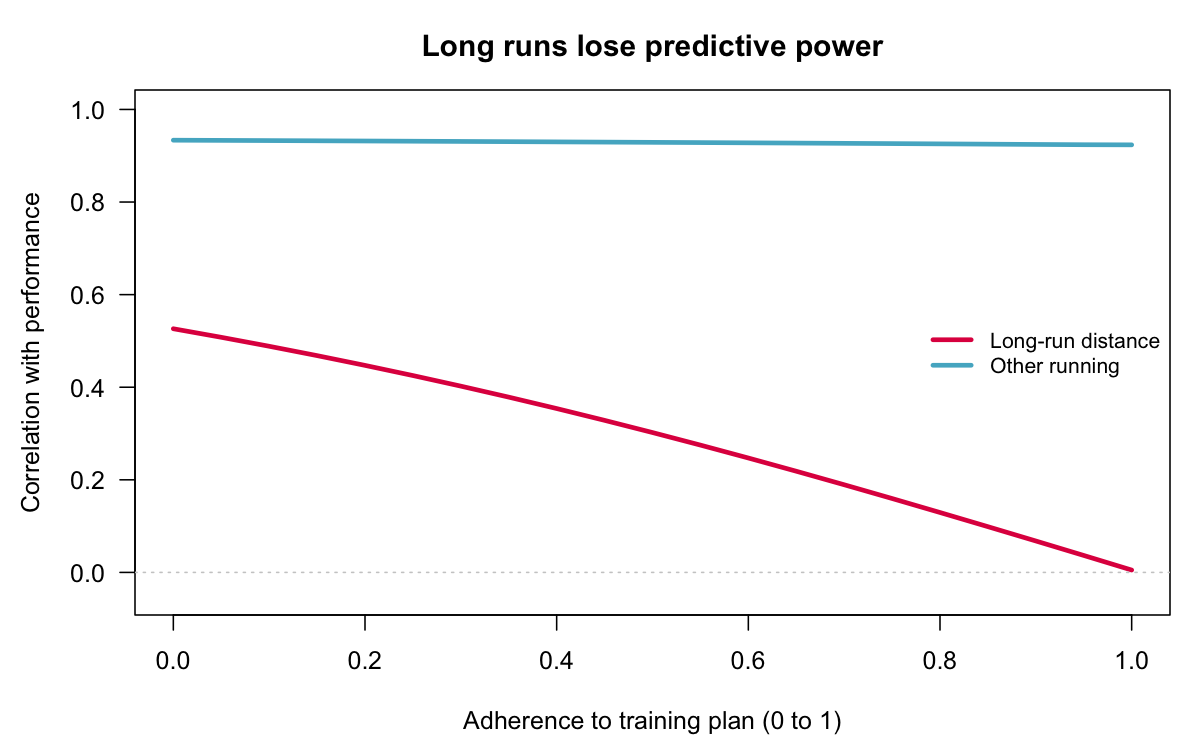 Other running, which remains a function of runner ability, does still predict marathon performance because it is still carrying a signal from underlying ability differences. This pattern matches exactly what the article reports we see in the data. Long runs aren’t predictive of marathon performance. They have little correlation with how fast someone completes a marathon, but other running is predictive of marathon speed.
The issue is that this difference in predictive ability between these two types of training runs does not say anything about causality. I’ve set up this example so that both regular training runs and long runs cause differences in marathon performance, but by working hard to ensure that they meet their training goals (in other words, by taking action), marathon runners are removing the predictive signal from the long run.
Lack of correlation doesn’t imply lack of causation
This is a case where we have the converse of the usual statement about correlation and causation. Here, failing to find correlation doesn’t mean there isn’t causation. In fact, in cases where people are targeting behavior around a variable, that variable can appear to have no correlation with – can fail to predict – an outcome even if it is causally important for that outcome.
The interesting thing to me about this case is that it’s the very importance of the long run that causes them to apparently no longer affect marathon performance. The harder people work to ensure they hit prescribed long run training targets, the less those runs reveal about differences in ability across runners.
Other examples
Marathon training is by no means the only place where this phenomenon shows up. A simple case is test scores with ceiling effects. If people study to increase test scores and that pushes them up against the score ceiling, the test becomes less informative about the ability being tested. Like in the marathon case, the more important the test, the more people might try to maximize their scores.
In my own work on forecasting, I’ve talked about how forecasts can turn out to be biased because of people taking action based on them. There was actually an example of this phenomenon at the end of 2025, as related by Balanced Weather:
This important story published this afternoon by KUOW public radio shows that … based on the NWS forecast of incredible, all-time record flooding, the US Army Corps of Engineers (USACE) took over the operations of two dams on the Skagit River owned by Puget Sound Energy and used the dams to control the downstream flooding of the river. This is why the forecasts were “in error” - the USACE was able to use the reservoirs to store enough water to take 4 to 5 feet off the crests.
Like the marathon training example, if weather forecasts induce protective action, then it can look as if weather doesn’t cause damage but just because people are acting to avoid the damage.
There are similar cases in the medical world. If a biomarker associated with an adverse health event is used to diagnose and treat that issue, then it will look like the biomarker is no longer predictive of adverse health.
Version history
2026-10-16: First version